When teachers look at MAP Growth vocabulary scores, it’s natural to assume the test is measuring one thing: how many words a student knows.
But that’s not actually what MAP is measuring.
The MAP vocabulary continuum is less about word quantity and much more about how students reason about words. Understanding this shift can completely change the way we interpret scores—and how we support students in improving them.
Instead of a simple list of harder and harder words, the vocabulary continuum actually follows a developmental progression in how students think about language.
Let’s look at what that progression really looks like.
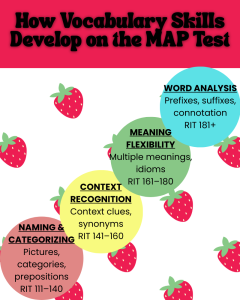
Stage 1: Naming and Categorizing (RIT 111–140)
At the earliest levels of the continuum, students are demonstrating that they can connect words to real-world concepts.
Questions at this stage focus on foundational vocabulary skills such as:
- Identifying pictures from clues
- Recognizing attributes of objects
- Sorting items into categories
- Understanding basic spatial prepositions (on, under, behind, between)
- Matching simple definitions
A typical question might ask:
Look at the picture of a red apple. Which word describes the apple?
Students at this stage are learning to label the world around them with words. The focus is not abstract thinking—it’s building clear connections between language and concrete experiences.
Stage 2: Using Context (RIT 141–160)
Once students can recognize and categorize words, the continuum begins asking them to use context to determine meaning.
Skills at this stage include:
- Using context clues in a sentence
- Understanding compound words
- Recognizing inflectional endings like -s and -ing
- Identifying synonyms and antonyms
- Interpreting very simple idioms or figurative language
A question might look like:
The puppy wagged its tail happily. What does happily mean?
Here, students are using surrounding information to figure out the meaning of a word—even if they haven’t explicitly learned it before.
Context becomes the key.
Stage 3: Flexible Word Meaning (RIT 161–180)
At this stage, vocabulary becomes more complex—not because the words are rare, but because words can have more than one meaning.
Students must begin recognizing that language is flexible.
Skills include:
- Multiple-meaning words
- Domain-specific vocabulary
- Idioms and figurative language
- Connotation differences between similar words
For example:
The phone will ring soon.
She wore a ring on her finger.
Students must recognize that the same word can mean different things depending on context.
This stage often surprises teachers because students who appear to have strong vocabularies sometimes struggle here. The challenge isn’t knowing the word—it’s understanding which meaning fits the situation.
Stage 4: Word Analysis (RIT 181+)
At the highest levels of the continuum, students begin analyzing how words are built.
Skills now include:
- Prefixes and suffixes
- Base words and word parts
- Dictionary and glossary use
- Subtle connotation differences
- Nuanced word choices
A question might ask:
How does the prefix mis- change the meaning of the word “misread”?
Students are no longer just interpreting words. They are beginning to analyze how language works.
The Big Insight: MAP Isn’t Testing Hard Words
When we zoom out across the continuum, the progression becomes clear:
Labeling → Context → Flexibility → Analysis
It’s important to remember that the MAP Learning Continuum is exactly what its name suggests: a continuum. Skills don’t appear in only one RIT band and then disappear in the next. Instead, they gradually increase in complexity as students move up the scale.
For example, students may encounter questions involving prefixes in bands lower than the highest levels, and inflectional endings like -s or -ing can still appear in higher bands. What changes across the continuum is not just the skill itself, but how much reasoning students must use to apply it.
MAP vocabulary scores don’t simply increase because students know bigger words. They increase because students become better at reasoning about language.
That’s why vocabulary scores can sometimes surprise teachers. A student might know many words but still struggle with:
- Multiple meanings
- Figurative language
- Connotation
- Word structure
These skills require a different type of thinking.
What This Means for Instruction
If we want to support vocabulary growth, focusing only on memorizing new words isn’t enough.
Students also need opportunities to practice:
- Sorting and categorizing words
- Using context to infer meaning
- Comparing similar words
- Exploring prefixes and suffixes
- Interpreting figurative language
Vocabulary growth happens when students move beyond recognizing words and begin thinking about how words work.
Understanding how vocabulary skills develop across the MAP continuum can make a big difference when interpreting student scores and planning instruction. When we recognize that students move from labeling and categorizing words toward analyzing how language works, we can provide practice that matches where they are in that progression.
As I continue developing MAP-aligned vocabulary resources for the Strawberry Series at Order in the Orchard, my goal is to reflect this same developmental progression—helping teachers target the types of word reasoning students are likely to encounter at different RIT bands.
Because at the end of the day, vocabulary isn’t just about knowing words.
It’s about understanding language.